Wide Ruled & Wide Ruled 2.0
A Friendly Graphical Authoring Environment for Author-Goal Based Story Generation
Abstract & Overview
Wide Ruled is an interactive story authoring and generation environment based on Michael Lebowitz’s UNIVERSE author-goal-based planning model. It extends the classical UNIVERSE formulation with support for asynchronous reader interactivity, episodic memory (Plot Points), and a guided graphical interface designed specifically for creative writers and students with little or no programming or AI planning background.
By framing hierarchical task network (HTN) planning concepts in familiar narrative terminology—Characters, Environments, Plot Points, Author Goals, and Plot Fragments—and providing step-by-step constraint wizards with static variable-scope validation, Wide Ruled enabled non-programmers in classroom and workshop settings to construct complex, backtracking generative stories.
Core Story World Architecture (#v2)
1. Story World Objects
- Characters & Environments: Entities defined by strongly typed Shared Traits (Text, Number, or True/False) and directed, asymmetric weighted Relationships (storing both a target entity reference and a numeric relationship strength).
- Plot Point Types (Episodic Memory): Schema definitions for dynamic narrative events (e.g., a Murder plot point recording the victim, weapon, and location). Instances of Plot Points are created, queried, and mutated on the fly during story generation to maintain long-term narrative state.
- Author Goals & Plot Fragments:
- Author Goals represent high-level narrative intentions (e.g., “Characters Meet” or “Investigate Crime Scene”) and accept typed parameters passed from parent goals.
- Plot Fragments represent concrete ways to fulfill a parent Author Goal, consisting of ordered Precondition Statements and Story Actions (variable calculations, world-state mutations, dynamic text emission, interactive reader prompts, and recursive Pursue Subgoal calls).
2. Continuous Maintenance Constraints (“Must Always Be True”)
Wide Ruled 2.0 introduced continuous maintenance constraints on preconditions. When a precondition constraint is marked Must Always Be True, the planner actively monitors that condition across the entire recursive subtree of pursued subgoals. If a deeply nested subgoal mutates the world state in a way that violates the ancestor constraint (for example, a character’s Alive trait becoming False mid-scene), the planner immediately unwinds that execution branch and backtracks to select an alternative Plot Fragment consistent with the new world state.
3. Execution & Backtracking Model
Story generation proceeds via randomized depth-first search with full state rollback:
- Evaluate all candidate Plot Fragments for the active Author Goal against the current world state and incoming goal parameters, binding matched traits or entities to local variables.
- Select a valid Plot Fragment (either randomly among satisfied candidates or via an interactive reader choice prompt) and execute its ordered Story Actions.
- If a recursive subgoal fails to find any valid Plot Fragment, undo all world-state mutations and text output from the current Plot Fragment and backtrack to try remaining candidate fragments.
4. Variable Scope & Ordering Reference
| Plot Fragment Component | Accessible Variables in Scope |
|---|---|
| Precondition Statement | Author Goal parameters + variables bound in previous Precondition Statements |
| Constraint within a Precondition | Author Goal parameters + variables from prior Precondition Statements + variables bound in earlier constraints of the same statement |
| Story Action / Step | Author Goal parameters + all Precondition variables + calculation/creation variables from previous Story Actions |
Screenshots & Figures
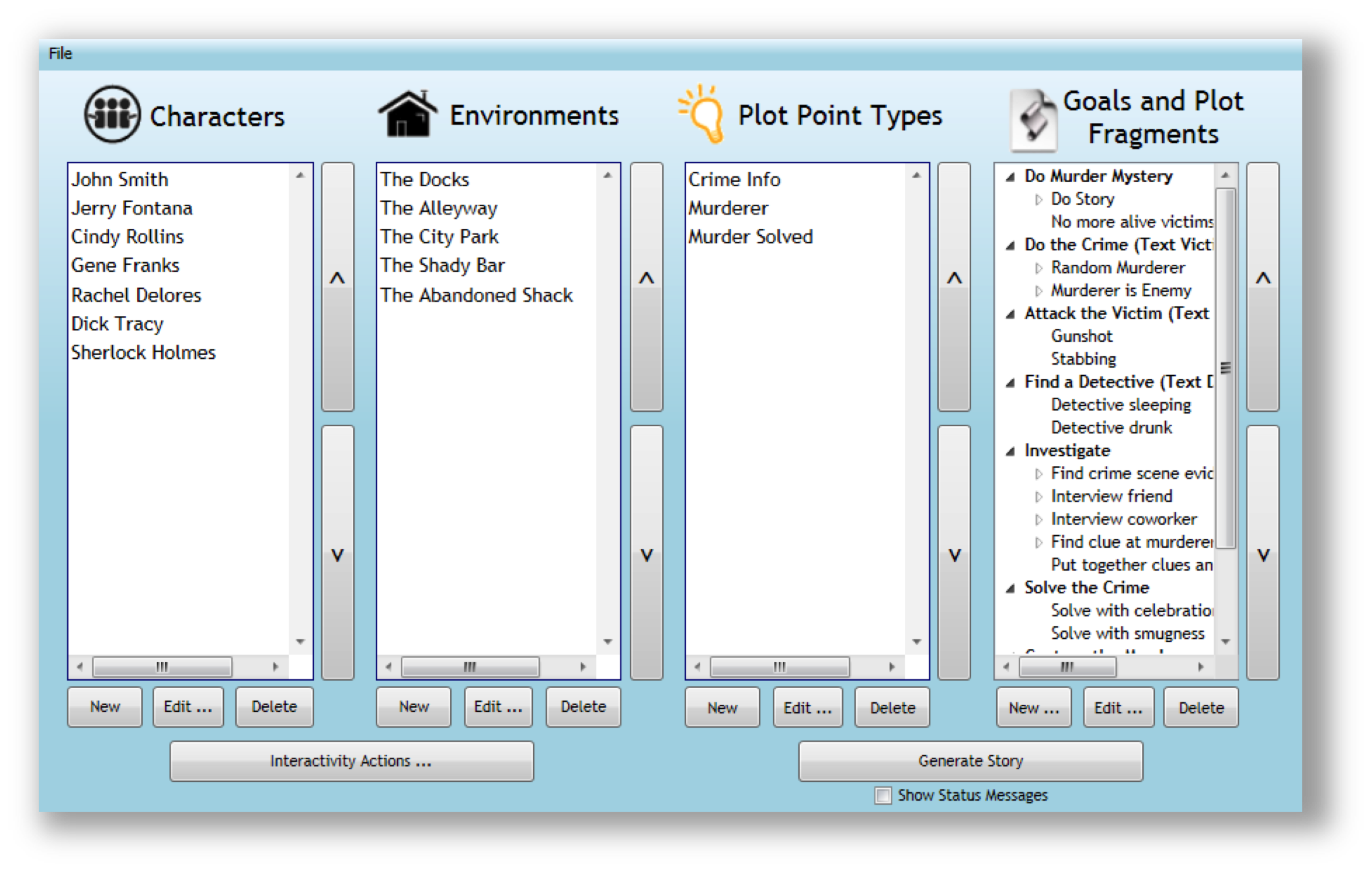
Main Window: Managing Characters, Environments, Plot Point Types, and Author Goal hierarchies.
Plot Fragment Editor: Guided constraint builder, variable binding, and ordered story actions.
Story Hierarchy: Recursive Author Goals (bold), Plot Fragments, and pursued subgoals (italics).
Story Generation & Interactivity: Real-time plan trace and asynchronous reader interaction prompts.